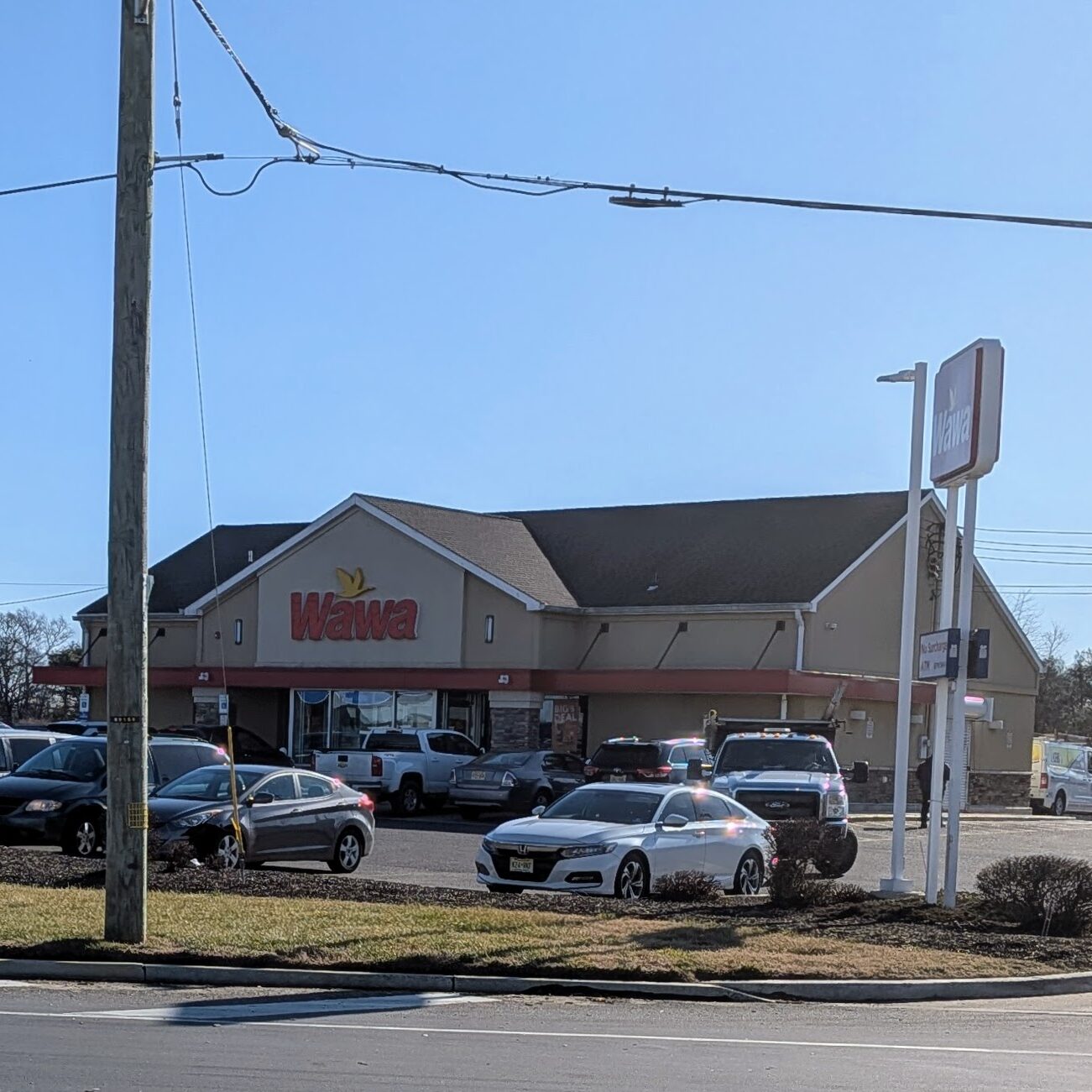
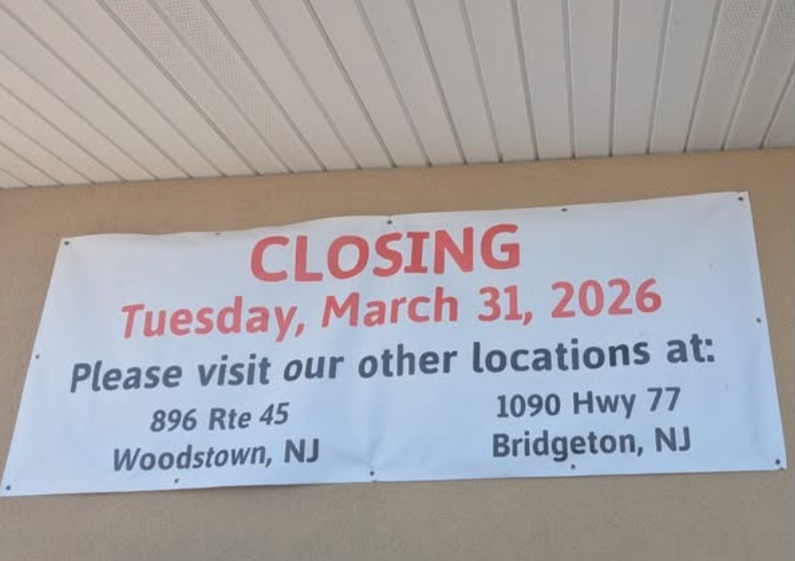
UPPER PITTSGROVE TWP. – The Wawa located at the Pole Tavern Circle in Upper Pittsgrove Township is set to close 3/31/26. It is to be closed for several months as the old building is demoed and a “Super Wawa” is built. The construction of the new storefront will also include the installation of gas pumps.
The location was the last remaining standalone store or “legacy” style store in the area.
Please, visit their other locations.
Allegedly, the anticipated opening of the new store will be after the summer rush in September 2026.
Learn a bit about the infamous chain store’s history and more via its website.
Whether you’re an avid angler or a weekend hiker, Daretown Lake in Upper Pittsgrove Township offers a peaceful escape into the heart of Salem County’s natural beauty. Located on CR 635 (Woodstown-Daretown Rd.), this public space is open daily from dawn to dusk, providing a perfect backdrop for outdoor recreation.
Fishing and Access
Daretown Lake is a favorite local spot for freshwater fishing. According to NJ Fish Finder, the lake is home to a variety of species, including:
Largemouth Bass
Chain Pickerel
Catfish
Perch
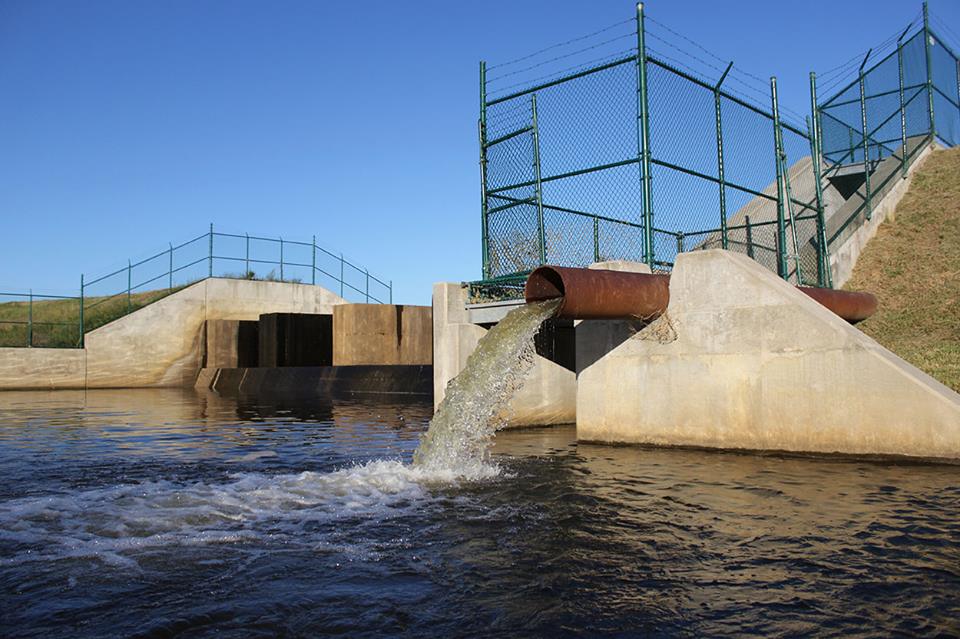
Visitor Tip: Public parking is located on Fox’s Mill Rd. From the pull-off area, you can follow a scenic trail that leads past the lake’s spillway and continues along a winding freshwater stream. Please ensure you have the proper New Jersey State fishing permits before casting your line.
Exploring the Ecosystem
The lake is framed by a picturesque mix of active farmland and dense, mature forest. The clarity of the water makes it easy to spot aquatic life, such as musk turtles, right from the bank.
As you follow the stream into the woods, the habitat shifts, becoming a haven for birdwatchers. Keep an eye out for:
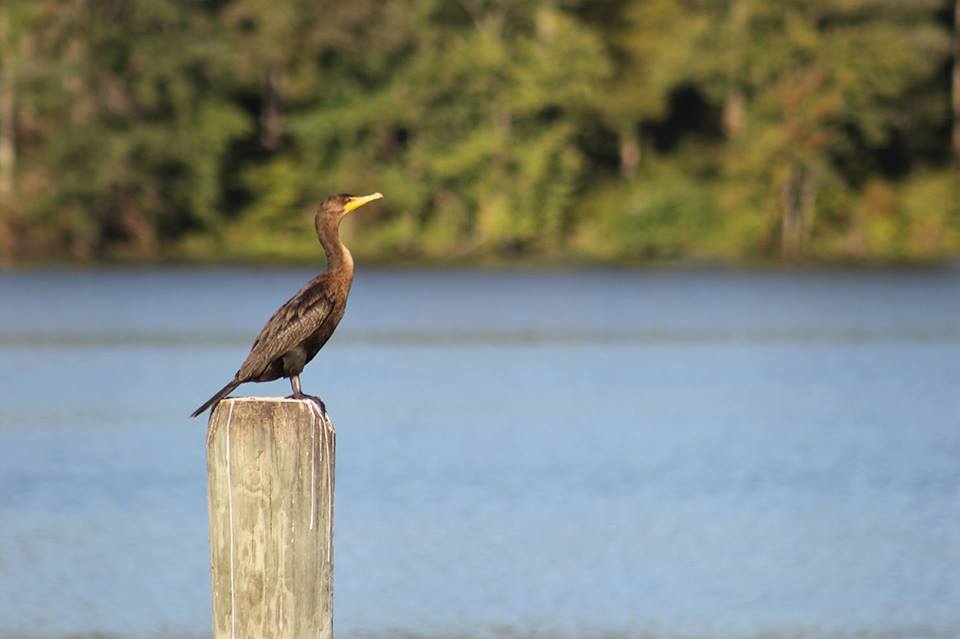
Great Blue Herons hunting along the shoreline.
Hairy, Downy, and Red-bellied Woodpeckers nesting in the timber.
Great Blue Heron in Elsinboro by Cheryl Leonard
Wildlife Through the Seasons
Daretown Lake offers a different experience with every change in the weather. Here is what you can expect to see throughout the year:
Winter: The Night Watch
The colder months are perfect for tracking the forest’s nocturnal residents. Look for the distinct prints of skunks, rabbits, deer, and foxes in the snow or mud. If you visit in the early evening, listen for the hooting of the Great Horned Owl or the Screech Owl.
Spring: A New Beginning
Life returns to the trail in full force during the spring. This is the best time for an early morning walk to catch the arrival of migratory songbirds and observe the bustling “streamside life” as the ice thaws.
Summer: Deep Forest Shade
In the summer heat, the forest provides a cool, shaded canopy.
Birding: Look for Purple Martins lining the telephone wires over the lake or Ruby-throated Hummingbirds darting between woodland blooms.
Pro Tip: Be sure to bring insect repellent, as the old trees and nearby water mean the bugs are as active as the birds!
Originally, in 1845, the land where Riverview Beach Park in Pennsville was a farm with a tavern and a ferry. In 1851, a building called the Silver Grove Hotel opened on the property. The hotel was named for the 16 silver maple trees planted between it and the river. Starting in 1889, Mr. Samuel Taylor sponsored the first annual farmers’ picnic. Year after year, the event grew gaining attention as well as new attractions such as a merry-go-round and some of the first publicly used phonographs. A barber shop and a store were soon added between the hotel and Front Street due to the influx of people visiting the park.
Mr. Acton’s Vision for an Amusement Park
Then in 1914, Mr. William D. Acton had a vision for a much larger and more appealing look for the grounds. He opened a small amusement park between Main Street and West Pittsfield Street which included swings, a picnic area, a larger merry-go-round, a beautiful sandy beach, and a dance hall that hosted movies once a week for 5 cents. This began to draw many out of state visitors to the area especially in the summer. During the summer months families on vacation from out of state rented cottages along the riverfront.
The White Line ran steamboats down from Philadelphia and Delaware to Riverview Beach Park, and they were always jammed packed (as seen in the photos). The “Adelaide” and the “Queen Anne” were two of the luxurious watercraft dawned with ivory, marble, and the finest of linens.
Hundreds waiting in line in the early 1900’s
New Additions of Roller Coasters, a Pool, and more!
In 1922, owner Mr. Acton decided to purchase the adjoining 30 acre Baker Farm which made the park one of the largest in South Jersey. With pressure building to peak the interest of new visitors, he decided to add new attractions. These new attractions included an airplane ride, water slide, a Ferris wheel, a roller skating rink, and a 75ft x 150ft swimming pool which held 60,000 gallons of water. In 1936 when complete, the Olympic sized pool cost $150,000.
Olympic sized swimming pool added to Riverview Beach Park in 1936
In 1953, after years of owning and managing the park and its 300 plus employees, Mr. Acton finally decided to pass the torch of ownership to Alvis Wallace who immediately sold the park to F.C. Morton of Salem that very same year.
At its peak, Riverview Beach Park offered five Ferris wheels, two roller coasters (pictured), a roller skating rink, a dance hall, plus more! Of course, there were also dozens of food venues for the thousands of visitors to enjoy while at the park.
Four years later, the park was again sold. This time to Riverview Lines Inc. for a whopping $700,000. Unfortunately, with the rapid decline of industry in the area & the overall number of visitors in general, the riverboat ferries were discontinued in 1961, and the amusement park was eventually abandoned.
Today’s Riverview Park
Since then it has been known as Riverview Park, and even though the luster and majesty of yesteryear has come to pass, the park is still enjoyed by families and friends alike on a daily basis. So, the next time you’re at the annual Septemberfest celebration or just simply strolling along the river for an afternoon walk, ponder this: You’re not the first to be there enjoying the park nor will you be the last!
PILESGROVE TWP: Earlier this morning, 3/21/26 around 10:36AM there was a very serious accident in Pilesgrove Twp. at Point Airy Rd. and Swedesboro Rd. The accident is reported to have been with 3 vehicles including a NJ Transit bus.
One patient requires Advanced Life Support for head trauma and medical evacuation, with two additional Basic Life Support units requested for mutual aid from Gloucester County.
Our thoughts and prayers are with the victims.
Far away view of the accident on March 21, 2026 on Swedesboro Rd. and Point Airy Road in Pilesgrove Twp.Far away view of NJ Transit bus involved in the MVC this morning.
[broadstreet zone=”187149″]
Google Maps image of the area in which the MVC happened this morningPhoto of NJ Transit bus involved in the Accident this morning.
With no centralized county shelter, the grueling work of catching and rehabilitating dumped dogs falls on one relentless volunteer.
SALEM COUNTY – In the dead of winter, while most of Salem County is asleep in heated homes, Cindi Strong, (30-year-old Woodstown resident raised in Pennsville) is awake, staring at a map, and waiting for a trap to spring.
During a recent bitter stretch, Strong found herself driving through two back-to-back snowstorms running on just one to three hours of sleep a day. She wasn’t plowing roads or repairing power lines; she was tracking a terrified, abandoned Pitbull named “Roadrunner” across county lines.
“I have a bleeding heart for dogs,” Strong explains, brushing off the brutal conditions that would deter most people. “They remind me of babies. They are innocent and rely on us. The weather doesn’t stop me… I’m relentless until I safely capture the dog.”
For Strong, this relentless pursuit isn’t a paid county gig—it is a massive, solo volunteer operation that has exploded in scope. As a child, she used to ride around looking for loose dogs to return to their owners. When she began officially trapping dogs four years ago, she handled maybe five missing or dumped animals in her first year.
But a quiet, rural crisis has escalated drastically. In the past two years alone, Strong has rescued over 100 dogs. What used to be a call once a month has turned into multiple calls a day, transforming her into the unofficial, unpaid safety net for Salem County’s discarded pets.
Honey in one of Cindi’s traps after being on the run for 7 days.Cindi finally making contact with Honey who was dumped at 3 months old and was running for 7 days in Stow Creek.Honey in one of Cindi’s traps after being on the run for 7 days.
The Science of Survival: Entering the “Dumping Ground”
To understand why a single volunteer is logging sleepless nights in freezing temperatures, you have to understand the psychology of a dumped dog. When an animal is discarded on a rural backroad, they don’t just wait around to be saved.
“A dumped dog or a lost dog enters survival mode, and they only care about staying alive and safe,” Strong explains. “If not approached correctly, even by their own owner, they will run. Instincts take over, and normal behavior changes.”
Because a terrified dog views itself as potential prey, they become almost entirely nocturnal, bedding down safely during the day and searching for food under the cover of darkness. This is where Strong’s professional background gives her a crucial edge: Cindi is a dog trainer. She doesn’t just chase dogs; she outsmarts them.
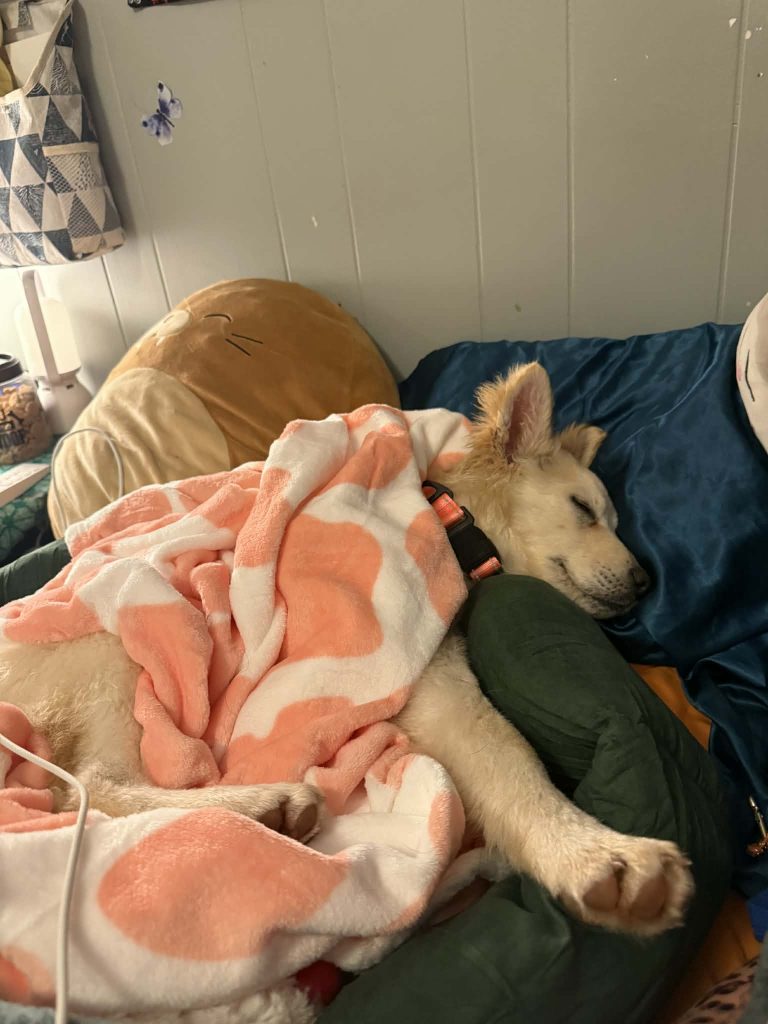
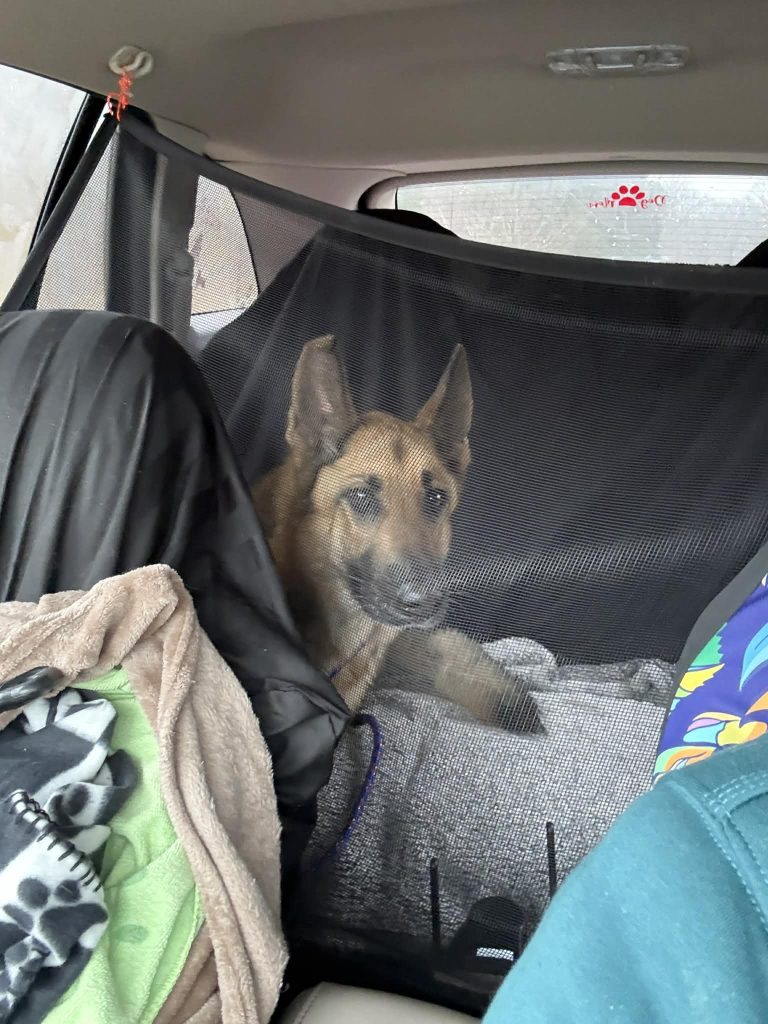
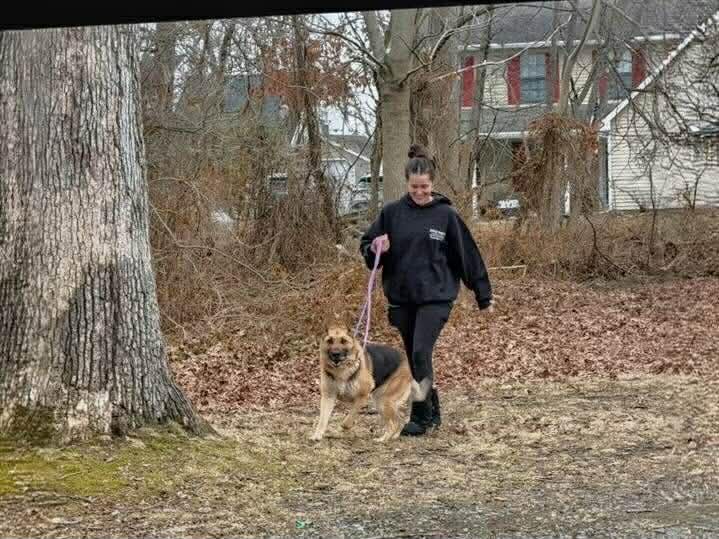
German Shepherd, Winter, after being trapped by Strong and slowly comforted back into human hands.
Strong approaches a rescue like a detective working a case. She maps out every single confirmed sighting, looking for behavioral patterns. She notes how the dogs follow power lines, stick to the woods, and navigate toward water sources. Once she establishes a pattern, she sets up feeding stations equipped with live-feed cameras to anchor the dog to a specific area. Only after a dog is consistently eating from the station does she finally deploy the trap.
“Trapping has actually made my training even more successful because I’m constantly studying dog’s behavior, trying to figure out where they are hiding and their next move,” she says.
But even with her expertise, the process is incredibly fragile.
After being saved, Winter goes for a ride in Cindi’s backseatWinter with new owners that Strong had found herself, just like the majority of the dogs she saves.
The Tragic Wait: When the System Fails
A carefully laid trapping plan can be shattered in an instant by well-meaning, but adverse, public interference.
Take the case of “Roadrunner,” the Pitbull dumped in Pittsgrove. She was on the run for 16 harrowing days. Instead of letting Strong work her methodical trapping process, people began chasing the terrified animal—some doing it out of frustration that Strong wasn’t capturing the dog fast enough.
“Roadrunner traveled 10 miles within 12 hours,” Cindi recalls of the chaotic chase. She was forced to deploy multiple traps across vast distances, driving through snowstorms to refresh the bait. All of this being done while running on only a few hours of sleep. She eventually secured Roadrunner when the exhausted dog finally settled in an isolated field in neighboring Gloucester County.
The infamous Roadrunner a Pitbull who was on the run for 16 days in Pittsgrove Twp. who was eventually caught in Gloucester County.Roadrunner after being caught and in the caring hands of Cindi.
Strong shouldn’t have been the only line of defense for a dog crossing county lines. However, the safety net in South Jersey is currently stretched past its breaking point. Strong covers all 15 municipalities in Salem County alone.
“Animal control isn’t required to trap,” Strong explains, pointing to the massive loophole in the municipal system. If a dog runs away before or as animal control arrives, the official response often ends there. The burden falls squarely back on volunteers.
But catching the stray dogs is only half the battle; the glaring issue is where to put them.
Yet, without a centralized county shelter, Strong often has nowhere to take them. Currently renting a small home while her house is being built, she physically cannot foster the dogs herself. In the past, she would sit in her car with a trapped dog for hours on end, desperately calling around for placement—a practice she had to stop because the stress became unbearable.
This bureaucratic void has fatal consequences. Strong points to “Winter,” a German Shepherd she recently tracked in Quinton.
“Winter had to suffer for a week longer because there was no shelter contract, and rescues don’t take stray dogs,” Strong laments. “I was posting every day asking for someone to hold her so I could trap her to safety.” Unless Strong can independently secure a placement, these dogs have to stay out on the run, risking starvation, freezing temperatures, or getting hit by a car.
Follow the Money: Salem County’s Stopgap Measures
By New Jersey state law, every county is required to have a functioning animal shelter. While Salem County has a nonprofit humane society and a municipal pound in Pennsville, the wider county has operated without a centralized, county-run facility to absorb the influx of abandoned animals from its rural townships.
Recognizing the crisis, local politicians have finally begun moving taxpayer money to address what they legally declared a “public exigency.”
The initial groundwork was laid in the fall of 2025 with Bond Ordinance 2025-005. This authorized up to $1.9 million for the acquisition and improvement of a property for a municipal animal shelter. However, buildings take time to secure and retrofit. Meanwhile they were scrambling for temporary fixes this winter while dogs like Winter and Roadrunner froze.
To bridge the gap, the Salem County Board of County Commissioners authorized tens of thousands of dollars in emergency contracts. In January 2026, they allocated an estimated $10,000 to send dogs to the Monmouth County SPCA through Resolution No. 1016-051. On 3/4/2026, another resolution (Resolution No. 2026-111) was passed dedicating an estimated $20,000 to the Pennsville Township Animal Shelter for temporary services.
The biggest announcement came at that same March 4th meeting. Resolution No. 2026-120 authorized the purchase of the property at 1059 Route 40 in Carneys Point Township for $450,000 “for use for county purposes specifically for utilization as a municipal animal shelter…and will be funded through Bond Ordinance 2025-005 enacted around 8/20/2025.”
Bridging the Gap Between Policy and Reality
This new property represents a massive beacon of hope for animal welfare in South Jersey. Once renovated and staffed, it will fundamentally change the landscape for abandoned pets and the volunteers trying to save them.
“People will have a place to take dogs to surrender them instead of dumping them,” Strong says, visualizing the relief the Carneys Point Township facility will bring. “Regular citizens who have a heart and pick loose dogs up will be able to take them to the shelter. Stray dogs won’t have to stay out, running scared longer than need be.”
But until the doors of that building officially open, the interim reality remains grim. The gap between a purchased building and a fully operational shelter is measured in months. For dogs dumped on the backroads of Pilesgrove Township or Quinton, survival is measured in hours.
Going from fielding one call a month to multiple calls a day has left Strong physically and emotionally drained. Yet, when asked how she keeps from burning out in the face of such a sheer volume of discarded animals, her answer is as relentless as her trapping methods.
“I’m exhausted,” she admits candidly. “But I focus on the difference I’m making. How many lives I’ve saved, and continue to.”
Nearly 120 years before the iconic rainbow jumpsuit and bright red hair of David Bowie, the United States had its own “Starman.”
The Original Star man of Philadelphia
He was one S. Ashton of Market Street, Philadelphia. Located there was a clothing store with a large star for a sign which included the number 16 in the middle. Ashton promoted himself as “star man” and around the year 1850 this “star man” made his way to Salem City.
A New Name for an Old Corner
During this time, Market Street in Salem was known as Bridge Street for it led to the only crossing of the Salem River at the time. Broadway was called Wharf Street. On the western corner where the two met stood Jones store. The corner was known as Jones Corner.
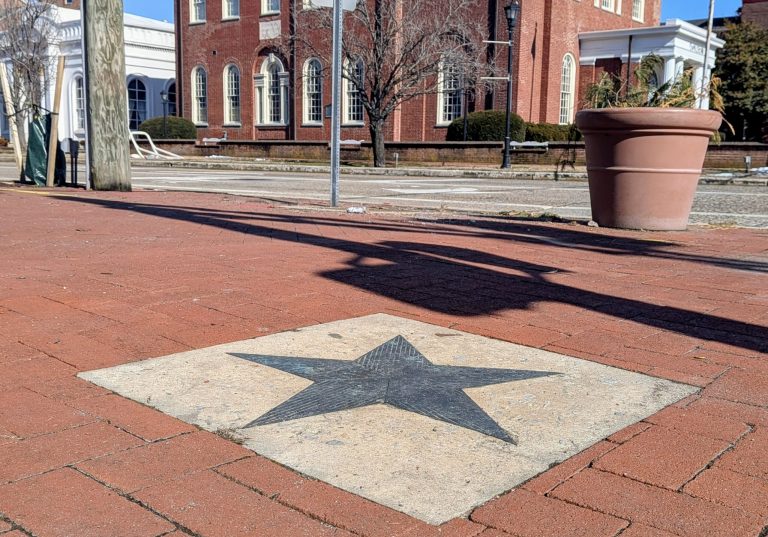
Ashton leased a portion of the old brick section of the store. Soon enough, the building became known as Star Hall. In 1898, Star Hall was torn down to make way for Salem’s City National Bank building which still stands today. That same year, a brass star was embedded in the sidewalk on the corner to recognize and carry on the old corner’s name.
The star embedded in concrete surrounded by brick on Star Corner in Salem City
Stepping on History: The Return to Salem City
The star not only serves as a symbol of the history of Salem City but, also, is a part of local folklore. Visitors of old and new are told that if they step on the star, they will one day return to Salem.
Sometime during 1996, the brass star was removed in order to polish and have it re-installed.
Preserving the Past: The 1996 Restoration
On the morning of Thursday, August 22, 1996, a small crowd of people gathered to see the treasured piece of history returned to the sidewalk. First, a 45 pound time capsule full of business cards, t-shirts, pins, and pictures all wrapped in acid-free paper to best preserve them was placed in the ground and concrete poured atop.
Finally, the polished brass star was placed in the fresh concrete and left to set just in time for the year’s Market Street Day, which followed that Saturday, August 24, 1996.
A Lasting Legacy on Market Street
Ernie Davis donated the concrete and my late grandfather, George Ahl, poured it then laid the star in its current resting place on Star Corner. Pictured is my grandfather embedding the star in concrete from the front page of Today’s Sunbeam on Friday August 23, 1996 (177th Year, No. 297).
We hope the next time you find yourself crossing Market Street that you look down and take the time to remember those who came before you and have “set into stone” (or concrete) their mark on this land.
Ray of sun shines down onto the Salem star with West Broadway in the background in center of Salem City
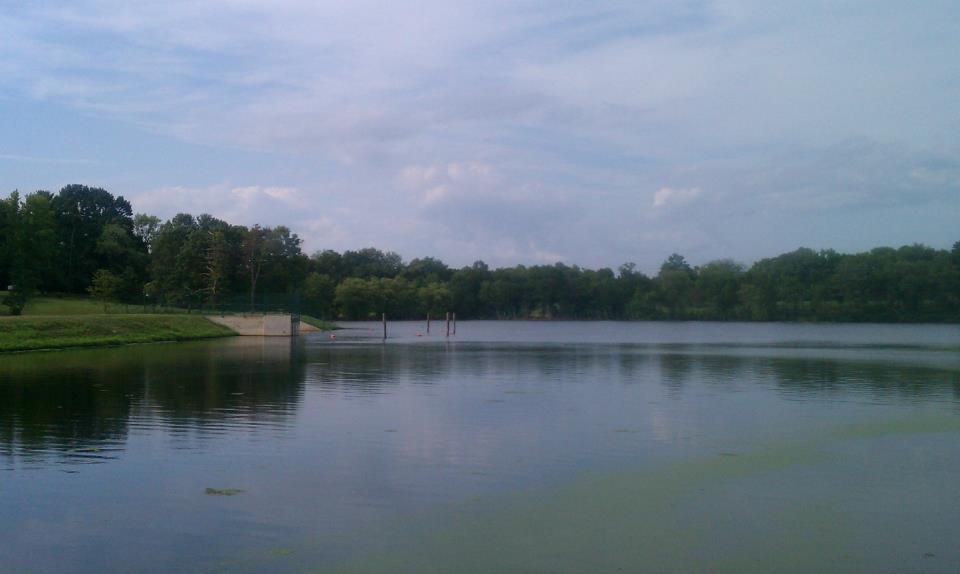
Following an extensive eight-year project to replace the dam and spillway, the 157-acre Alloway Lake officially reopened to the public in November 2009. Visitors can access the lake at 26 East Canal Street, where amenities include parking, picnic tables, a dock, a small basketball court, and a small boat launching ramp (subject to a launching fee).
To preserve the lake’s natural environment, only non-powered watercraft or those equipped with electric trolling motors are permitted. Currently, fishing is allowed on a catch-and-release basis only. For a full list of guidelines, visitors can consult the rules posted at the access site or refer to Chapter 42 of the online municipal code book from the official Township Website.
Geographic Profile of Alloway Lake
Alloway Lake is a significant reservoir located in Salem County, New Jersey. It sits at an elevation of approximately 2 meters (7 feet) above sea level.
The lake was originally created by damming Alloway Creek; over two centuries ago, it was known as Jessups Mill Pond. While the current dam is a recent addition, the site has been in continuous use since 1890, with a previous dam structure dating back to 1900.
The landscape of the lake has changed significantly over time. Roughly 135 years ago, a wooden structure known as Long Bridge spanned the water where Main Street now crosses. During that era, the lake and creek were essentially one, making the lake much larger than it is today. The current concrete bridge (County Bridge No. 1065) replaced an older 1930s structure. Similar 1930s-era masonry could also be found on the Greenwich Street bridge heading toward Woodstown-Alloway Road.
The Golden Age of Shipbuilding
In 1831, Josiah and William Reeve established a thriving shipbuilding industry along Alloway Creek. Their shipyard stretched along the beginning of the creek, parallel to what is now String Street. By 1848, the Reeve brothers employed over 100 people to construct schooners, canal boats, and steamboats—some of the largest vessels in the country at the time. Notably, the largest ship ever built in Alloway was a six-ton steamboat.
Because the water near the village was shallow, the larger vessel frames were constructed at the eastern end of Main Street (near the present-day hardware store). These massive frames were then floated through floodgates down to Lloyd’s Landing in Quinton Township, where the deeper waters allowed for final completion. The Reeves’ prosperity is still visible today in the three mansions they built along Main Street near the original shipyard grounds.
Alloway Lake’s Chronology of Stewardship
The ownership of Alloway Lake has passed through several prominent local families over the centuries:
1798: Samuel Holme inherited 150 acres of the property from his father.
1809: James Jessup purchased the property from Samuel’s widow, Margaret Holme.
1821: Josiah M. Reeve acquired the land from James Jessup.
1889: After a period of ownership by Benjamin Diament & Bro., Mary Ewen purchased the lake at a sheriff’s sale.
1921–1943: Earl B. Ewen acquired the property from his mother and later shared title with his brothers, Wade and John.
1951: The Ewen Brothers Corporation sold the lake to Belford L. Seabrook for $10,000.
A Legacy as a Summer Resort
Beyond its industrial history, Alloway was once a premier summer destination. According to local accounts in the book Alloway Remembers, many buildings in the center of town originally served as hotels for seasonal boarders. The beach off Canal Street was a “municipal affair,” developed through the collective effort of the township residents to create a shared community space for recreation. During the winters, the lake remained an economic hub as ice was harvested and stored in local ice houses owned by the Walton and Pancoast families.
Update on the coming Rastelli Foods Store in Salem
SALEM CITY, N.J. — A collective feeling of “at last” washed over the Old Salem Courthouse on Monday afternoon, March 9, 2026. Relief is officially on the horizon for Salem City residents as officials updated the public on the groundbreaking partnership to bring a fresh grocery store to Fenwick Commons on East Broadway in Salem City.
The initiative is a joint effort between Alloway-based Ranch Hope and Rastelli Foods, aiming to directly address Salem City’s long-standing status as a “food desert.” Currently, there are no grocery stores offering fresh food within the city limits, forcing residents to commute to the Walmart in Pennsville Township or the Acme in Pilesgrove for basic necessities.
The presentation to local citizens was led by Assemblyman Dave Bailey, who also serves as the CEO of Ranch Hope. Bailey, a driving force behind the project, introduced Ray Rastelli, the owner of Gloucester County-based Rastelli Foods. While Rastelli Foods is now a global food distributor boasting 1,400 employees and operating in numerous countries, Rastelli’s roots are decidedly local.
Rastelli shared his story of opening a local butcher shop in Oak Valley at just 19 years old. He built his business from the ground up through the support of friends and family, famously going door-to-door with his wife to ask local residents for their support. Speaking for over 10 minutes before taking questions, Rastelli emphasized a recurring theme: this new Salem City store will be just as reliant on the support and input of the community as the community will be on the grocery store.
State-of-the-Art Offerings and a Return to Home Cooking
The planned 2,000-square-foot, ground-level grocery store promises to bring all the bells and whistles of a high-quality market to Salem. Residents can expect fresh produce, seafood, and affordable, fresh prepared meals among much more.
Beyond just selling groceries, Rastelli spoke passionately about a core mission to promote cooking at home. He noted that younger generations often lack culinary experience, defaulting to “grabbing a sub from Wawa” instead of making that same sandwich at home for a fraction of the cost. By providing affordable, healthy, and fresh alternatives, the new store hopes to make home cooking the healthier and more economical choice for Salem families.
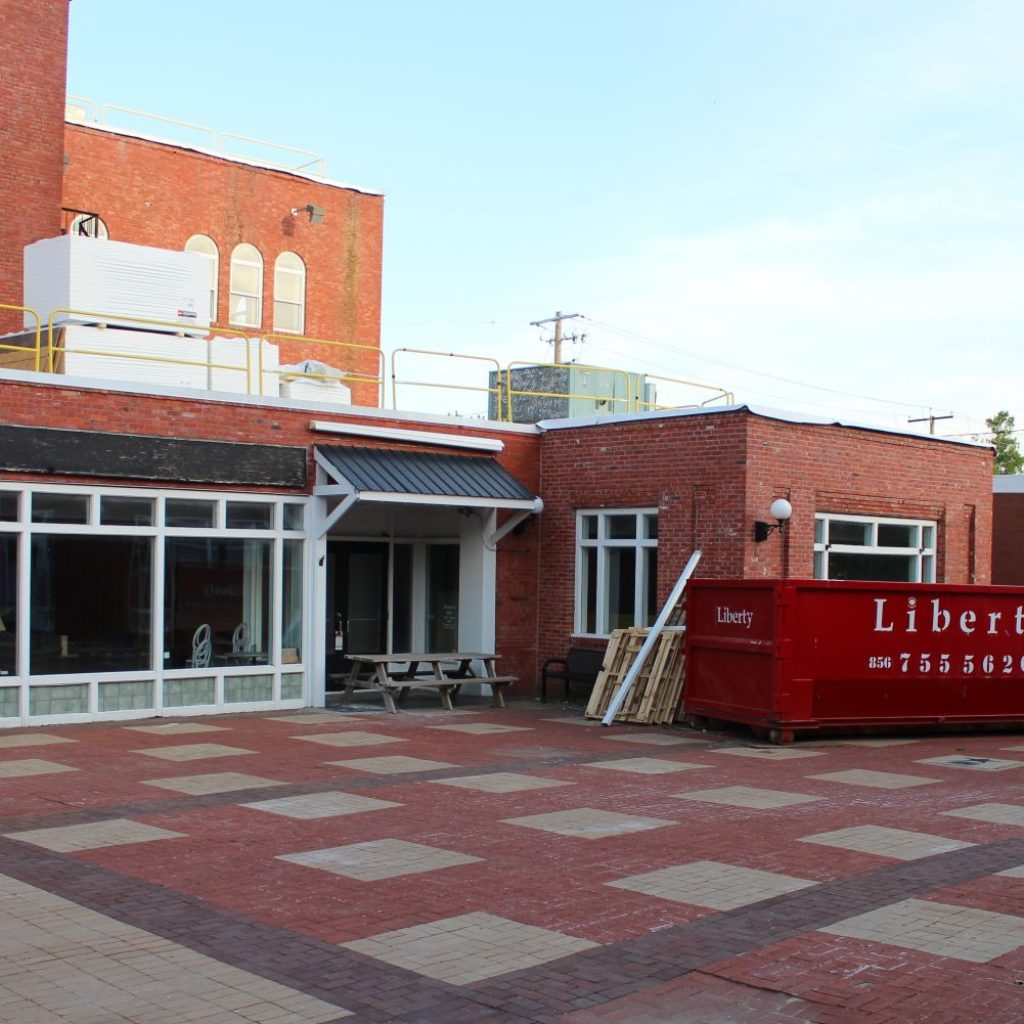
Location of the future grocery store in Salem in collaboration with Rastelli and Ranch Hope
Community Growth and Self-Sustainability
The vision for the Fenwick Plaza location goes beyond simply selling food. Rastelli emphasized that the store aims to create lasting career opportunities—not just jobs—for Salem citizens and residents of surrounding communities. The ultimate goal is to liven up the city, restore local pride, and make Fenwick Plaza a hub of growth that attracts further business investment.
Crucially, Rastelli addressed the long-term financial strategy. When asked if the store would rely on grants to stay afloat, his answer was a definitive “no.” The business model is designed to be entirely self-sustainable.
What’s Next? (What Will It Be Called?)
During the Q&A segment, officials addressed several practical community concerns:
Timeline: The store will open within 3 to 6 months, with advance notice given to the community.
Accessibility: The store will proudly accept SNAP benefits.
Parking: When asked about parking logistics, officials noted that they “are working on it.”
Perhaps the most exciting immediate next step is naming the store. Rather than bringing in a corporate name, Rastelli announced that he is letting the Salem community choose what the grocery store will be called.
The company is actively seeking feedback on both the name and what specific items residents want to see stocked on the shelves of their new 2,000-square-foot market.
Note from the Author: We attempted to reach Assemblyman Dave Bailey but did not receive a response.